Internal COMMIttee (IC) POLICY
(Prevention, Prohibition and Redressal of Sexual Harassment at Workplace)
Goa Vidyaprasark Mandal’s, Gopal Govind Poy Raiturcar College of Commerce and Economics is committed to providing a safe, secure, inclusive and gender-sensitive environment for all its employees and students. The College believes that every individual has the right to work and study
with dignity, equality and mutual respect.
The College adopts this policy in accordance with:
• The Sexual Harassment of Women at Workplace (Prevention, Prohibition and Redressal) Act, 2013 (POSH Act 2013);
• Sexual Harassment of Women at Workplace Rules, 2013;
• UGC (Prevention, Prohibition and Redressal of Sexual Harassment of Women Employees and Students in Higher Educational Institutions) Regulations, 2015;
• Any amendments issued by the Government of India, UGC or State Government from time to time.
This policy establishes the constitution, objectives, and procedural framework of the Internal Committee (IC) in accordance with the Sexual Harassment of Women at Workplace (Prevention, Prohibition and Redressal) Act, 2013 and relevant UGC/University Regulations.
Scope & Applicability of the IC Policy
• This policy applies to all students, teaching staff, non-teaching staff and any other persons associated with the College, while they are on campus.
• Any aggrieved woman, including a female student, teaching or non-teaching staff, who alleges sexual harassment may seek redressal through the Internal Committee (IC).
Constitution and tenure of IC
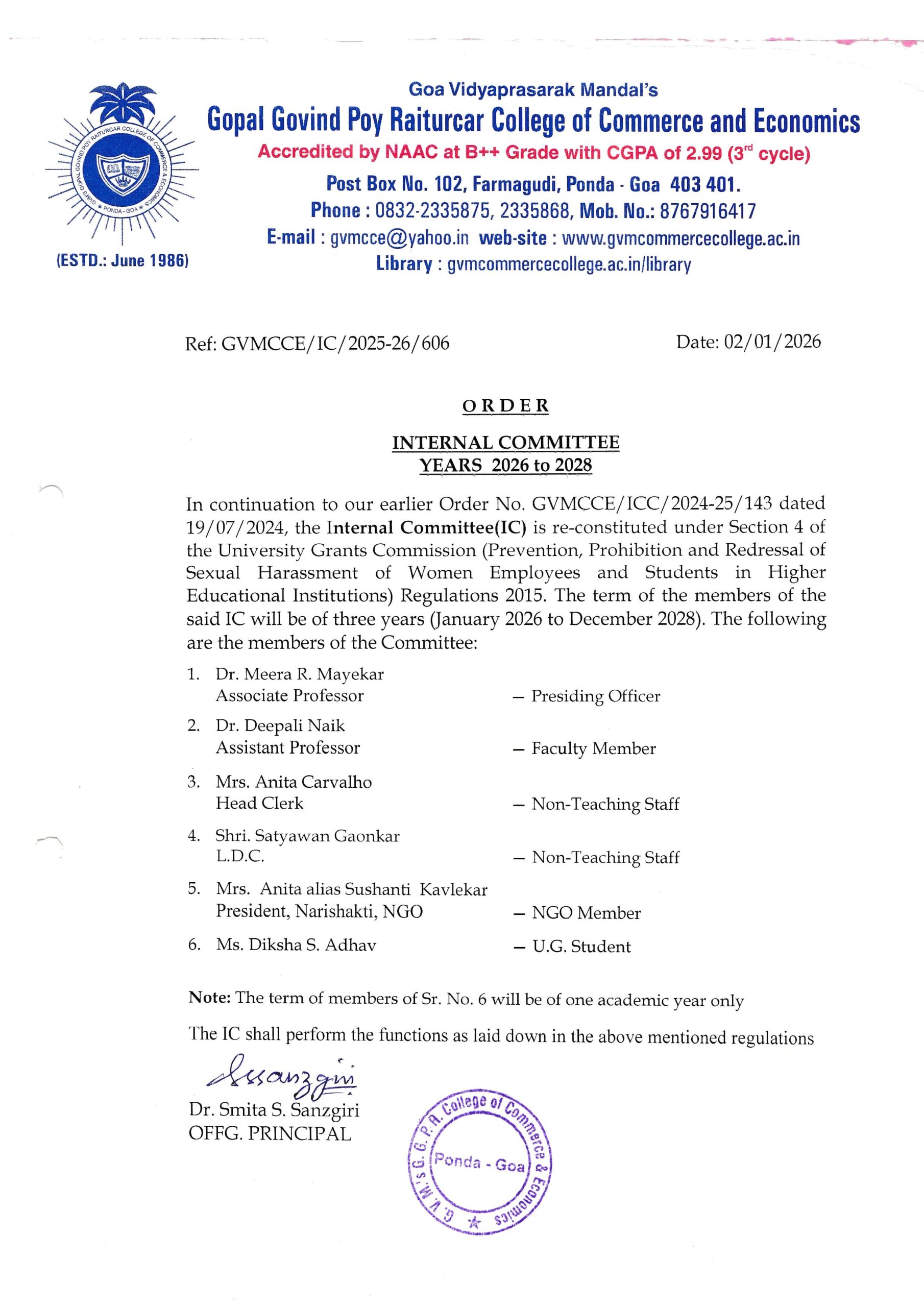
The IC shall be nominated by the Principal of the College and shall consist of the following members:
1. Presiding Officer, who shall be a woman employee at a senior level.
2. One teaching staff who have knowledge of Sexual Harassment of Women at Workplace (Prevention, Prohibition and Redressal) Act, 2013.
3. Two non-teaching staff members who have knowledge of Sexual Harassment of Women at Workplace (Prevention, Prohibition and Redressal) Act, 2013.
4. One student nominated by following proper procedure.
5. One external member committed to the cause of women or a person familiar with the issues relating to sexual harassment.
6. At least half of the total Members of the IC should be women.
7. Person in senior administrative positions in the institution, shall not be members of IC in order to ensure autonomy of their functioning.
8. The term of office of the members of the IC shall be period of three years. Institution may also employ a system whereby student member of the IC may change every year. The constitution of the IC for every academic year will be shown separately on the website.
Objectives of IC
• Develop and implement a comprehensive policy for the prevention, prohibition, and redressal of sexual harassment of women within the institution.
• Reinforce the institution’s commitment to providing a safe, secure, inclusive, and respectful campus environment that is free from discrimination, sexual harassment, retaliation, and sexual misconduct at all levels.
• Create awareness among students, teaching staff, non-teaching staff, and other stakeholders about what constitutes sexual harassment.
• Promote gender sensitivity, equality, diversity, and inclusion through awareness programmes, workshops, and sensitisation initiatives.
• Uphold the institution’s commitment to ensuring an environment free from gender-based discrimination and to safeguarding the dignity and rights of every woman.
• Provide a fair, impartial, confidential, and effective grievance redressal mechanism for the prevention, prohibition, and resolution of complaints relating to sexual harassment in accordance with the POSH Act, 2013.
• Ensure timely inquiry and appropriate action against acts of sexual harassment while adhering to the principles of natural justice.
• Encourage prompt reporting of incidents of sexual harassment without fear of retaliation, victimisation, or discrimination.
Key Definitions
Sexual Harassment: Includes any one or more of the following unwelcome acts or behaviour (whether directly or by implication):
1. An unwanted conduct with sexual undertones if it occurs or which is persistent and which demeans, humiliates or creates a hostile and intimidating environment or is calculated to induce submission by actual or threatened adverse consequences and includes any one or more or all of the following unwelcome acts or behaviour (whether directly or by
implication), namely;
a. Any unwelcome physical, verbal or non-verbal conduct of sexual nature
b. Demand or request for sexual favours
c. Making sexually coloured remarks
d. Physical contact and advances
e. Showing pornography
2. Any one (or more than one or all) of the following circumstances, if it occurs or is present in relation or connected with any behaviour that has explicit or implicit sexual undertones:
a. Implied or explicit promise of preferential treatment as quid pro quo for sexual favours
b. Implied or explicit threat of detrimental treatment in the conduct of work
c. Implied or explicit threat about the present or future status of the person concerned
d. Creating an intimidating offensive or hostile learning environment
e. Humiliating treatment likely to affect the health, safety dignity or physical integrity of the person concerned
Complainant: Any student or employee who alleges having been subjected to any act of sexual harassment.
Respondent: Any person against whom a complaint of sexual harassment has been lodged.
Complaint & Redressal Procedure
A. Submitting a Complaint of sexual harassment
1. An aggrieved person is required to submit a written complaint to the IC within three months from the date of the incident and in case of a series of incidents within a period of three months from the date of the last incident.
2. Provided that where such complaint cannot be made in writing, the Presiding Officer or any member of the IC shall render all reasonable assistance to the person for making the complaint in writing
3. Provided further that the IC may, for the reasons to be accorded in the writing, extend the time limit not exceeding three months, if it is satisfied that the circumstances were such which prevented the person from filing a complaint within the said period.
4. Friends, relatives, Colleagues, Co-students, Psychologist, or any other associate of the victim may file the complaint in situations where the aggrieved person is unable to make a complaint on account of physical or mental in capacity or death.
5. Complaints can be submitted physically (signed copy to the Presiding Officer) or via the dedicated IC email address internalcommittee@gvmcommercecollege.ac.in or through https://shebox.wcd.gov.in (She-Box). SHe-Box stands for Sexual Harassment e-Box. It is a centralized online complaint management system launched by the Ministry of Women and Child Development (MWCD), Government of India, under the POSH Act, 2013.
B. Conciliation (Optional)
• Prior to initiating an inquiry, the IC may, at the written request of the complainant, take steps to settle the matter through conciliation.
• No monetary settlement shall be made the basis of conciliation.
• If a settlement is reached, copies of the agreed terms are provided to both parties, and no further inquiry is conducted unless terms are breached.
C. Key Timelines & Formal Inquiry Process
If conciliation is not requested or fails, the IC shall proceed with a formal inquiry:
1. The IC shall, upon receipt of the complaint, send one copy of the complaint to the respondent within a period of seven days of such receipt.
2. Upon receipt of the copy of the complaint, the respondent shall file his or her reply to the complaint along with the list of documents, and names and addresses of witnesses within a period of ten days.
3. The IC conducts hearings, examines witnesses, and evaluates evidence. Both parties are given a fair opportunity to present their case.
4. Neither party is allowed to bring legal practitioners to represent them during IC proceedings.
5. The inquiry has to be completed within a period of ninety days from the receipt of the complaint.
6. The inquiry report, with recommendations, if any, has to be submitted within ten days from the completion of the inquiry to the Principal.
7. Copy of the findings or recommendations shall also be served on both parties to the complaint.
8. The Principal shall act on the recommendations of the committee within a period of thirty days from the receipt of the inquiry report, unless an appeal against the findings is filed within that time by either party.
9. An appeal against the findings or recommendations of the IC may be filed by either party before the Principal within a period of thirty days from the date of the recommendations.
10. If the Principal decides not to act as per the recommendations of the IC, then it shall record written reasons for the same to be conveyed to IC and both the parties to the proceedings.
11. If on the other hand it is decided to act as per the recommendations of the IC, then a show cause notice, answerable within ten days, shall be served on the party against whom action is decided to be taken. The Principal shall proceed only after considering the reply or hearing the Complainant.
12. The aggrieved party may seek conciliation in order to settle the matter. No monetary settlement should be made as a basis of conciliation. The HEI shall facilitate a conciliation process through IC, as the case may be, once it is sought. The resolution of the conflict to the full satisfaction of the aggrieved party wherever possible, is preferred to purely punitive intervention.
D. Findings & Recommendations
Upon completing the inquiry, the IC will submit its final report with recommendations to the Principal:
• If Allegations are Not Proven: The IC recommends no action.
• If Allegations are Proven: Recommendations may include:
o For Students: Written apology, reprimand, suspension, withholding scholarship/results, expulsion, or community service.
o For Employees: Written warning, withholding promotion/increments, suspension, demotion, termination of service, or mandatory counselling.
o Financial compensation to the victim, deducted from the respondent’s salary/stipend if applicable.
E. Confidentiality & Non-Victimization
• Strict Confidentiality: The identity and address of the complainant, respondent, witnesses, and all proceedings are strictly confidential. Any breach of confidentiality will lead to disciplinary action against the offender.
• Protection Against Victimization: The college ensures that no student or staff member is victimized, penalized, or retaliated against for filing a complaint or participating as a witness in an inquiry.
Action against frivolous complaint
To ensure that the provisions for the protection of employees and students from sexual harassment do not get misused, provisions against false or malicious complaints have to be made and publicised within all HEIs. If the IC concludes that the allegations made were false, malicious or the complaint was made knowing it to be untrue, or forged or misleading information has been provided during the inquiry, the complainant shall be liable to be punished as per the provisions of sub-regulations (1) of regulations 10, if the complainant happens to be an employee and as per sub-regulation (2) of that regulation, if the complainant happens to be a student. However, the mere inability to substantiate a complaint or provide adequate proof will not attract attention against the complainant. Malicious intent on the part of the complainant shall not be established without an inquiry, in accordance with the procedure prescribed, conducted before any action is recommended.
Date: 03/08/2026 Prof. Smita Sanzgiri